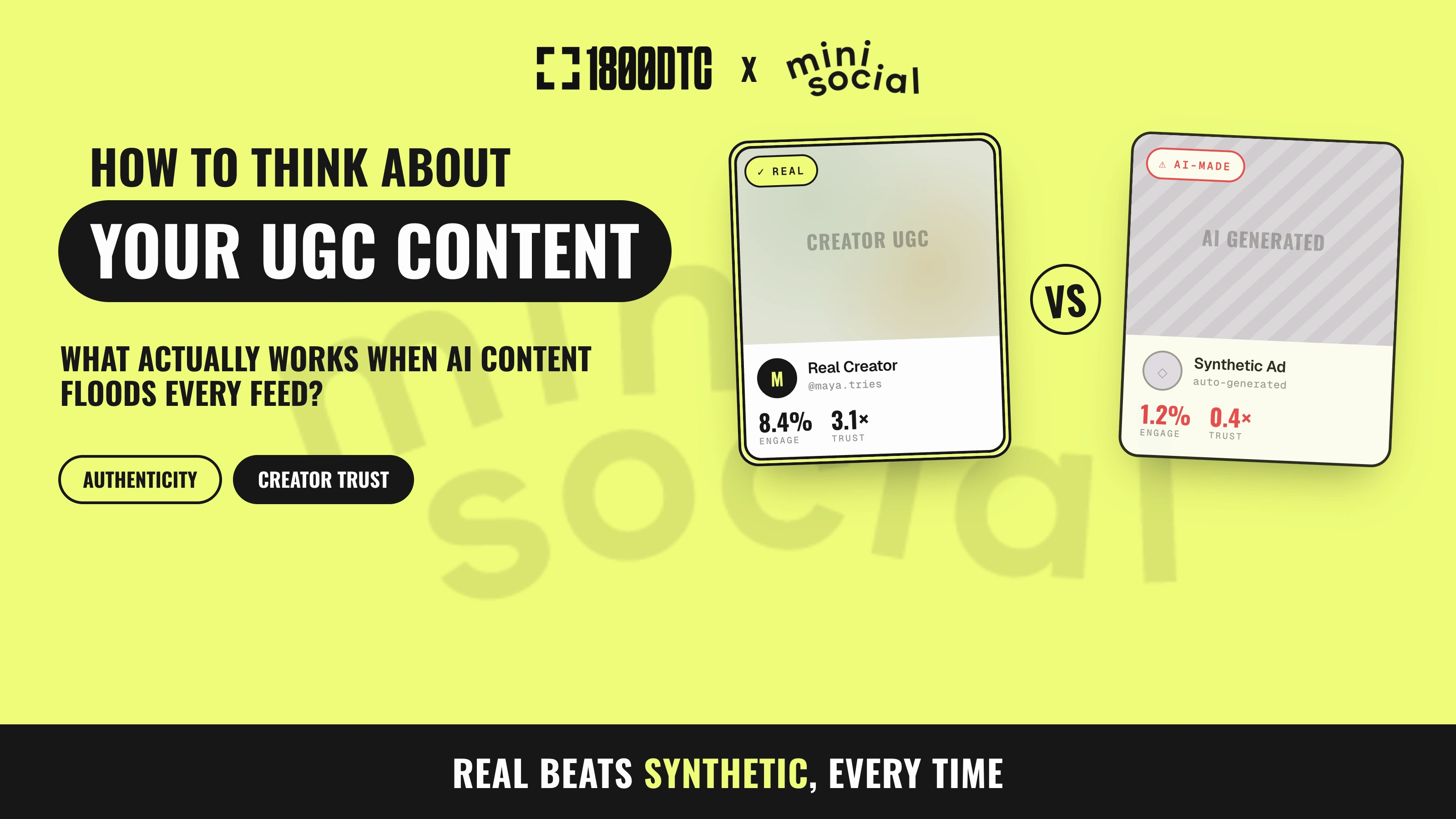
How to Think About Your UGC Content? What Actually Works When AI Content Floods Every Feed

Something shifted at some point during 2026, and if you're a DTC founder or operator sitting inside a 2027 planning window, you can already feel it. The creative treadmill got faster. The AI content flood arrived exactly as consumers turned skeptical of anything too polished. Paid social lifecycles collapsed to a handful of days. UGC quietly became one of the highest-leverage assets a DTC brand can own.
With all of this happening, it’s important to know exactly what to be looking at when planning for next year. This practical guide for the operators who are making the calls right now covers what changed, what's working, and how to build a UGC engine that holds up in 2027. Whether you’re deciding to sign with a platform like minisocial, hire a freelance creator, or roll the dice on AI-generated content, be the most prepared and educated you can be so you crush the upcoming year.
What Actually Changed in UGC in 2026
Consumer trust in AI content collapsed
Consumer preference for AI-generated creator content dropped from 60% in 2023 to 26% in 2026, according to Billion Dollar Boy. Only 4% of marketers actively trust AI content for brand-facing work, despite 81% using generative AI in their workflows. The pendulum didn’t swing back, it broke.
Creative lifecycles compressed
Winning UGC ads on TikTok and Instagram Reels now fatigue within three to five days. Meta's 2026 Performance Advertising Benchmark, which analyzed 3,400 advertiser accounts, found UGC-powered ads delivered 4.7x higher click-through rates than studio-produced brand ads, cut CPC by 56%, and drove customer acquisition cost (CAC) reductions up to 62% for DTC apparel and wellness brands.
The performance case is settled. The catch is you need a constant intake of fresh content, not just iterations of the same ad. One hero video isn't a strategy anymore.
The Five Moves That Define Your 2027 UGC Strategy
1. Treat authenticity as a defensible moat, not a vibe
The brands winning in 2027 are leaning into what AI genuinely cannot replicate: real humans holding real products in real environments. The keyword here is something “real”. A shaky iPhone video from someone's actual kitchen will on average outperform a polished post. This is a performance position, not a philosophical one.

Real micro-influencer content scales this without breaking the authenticity signal. Founded and led by Kirsten Baumberger, the model minisocial has, pairing DTC brands with creators who actually do the filming, is the exact opposite of the AI-avatar-in-a-generic-living-room playbook. When Olipop, Native, and Nom Nom activate this network, the assets feel like they were pulled from a real customer's feed. In a meaningful sense, they were.
Takeaway: Human-made content is now the moat. Build for it.
2. Build for creative velocity, not one hero ad
The biggest strategic error DTC brands are still making in mid-2026 is investing in a single expensive "hero" creative and expecting it to run for weeks. Ad lifecycles do not allow that anymore.
The 2027 approach is a constant intake of fresh assets: dozens of variations per month across unboxings, demos, testimonials, POV shots, and product-first hooks. A $3,000 minisocial campaign with 10 creators delivers a batch you can slice and test for months. Compare that to hiring one freelance creator at $300 a video and the math shifts fast.
Takeaway: Volume beats polish. Plan for monthly intake, not one-off shoots.
3. Own the licensing chain end to end
This is the sleeper issue that will bite unprepared brands in 2027. If you're running paid social with UGC, you need clean, permanent rights to every asset. Not "let me check with my agent." Not "usage expires in 90 days." When a winner scales into six figures of spend, the last thing you want is a legal review holding up your best creative.
minisocial's mini license is worth understanding as a category benchmark. Every asset comes fully licensed for paid, organic, web, print, and email, with no expiring windows or model releases. Brands like Blueland, Magic Spoon, and DoorDash use that structure to move fast without rights disputes six months later.
Takeaway: If your pipeline can't guarantee 24 months of paid usage without renegotiation, that's your first 2027 fix.
4. Design UGC to be discoverable by AI search
AI Overviews, ChatGPT, and Perplexity increasingly answer purchase-intent queries by citing real customer language. "Best natural deodorant for sensitive skin" gets answered with review snippets, not brand copy. Specificity is what gets extracted: "kept me dry through a 90-minute workout" makes it in; "great product" doesn’t.
Your UGC briefs in 2027 should ask creators for concrete details. Time durations. Specific use cases. Direct comparisons. This is not gaming AI search. It's the content both humans and models find useful. Brands treating UGC as an AEO asset, not just paid social fuel, will pull ahead.
Takeaway: Brief for specificity. Vague content does not get cited.
5. Combine reach and content library in a single motion
DTC brands historically treated influencer marketing and UGC as separate line items. Influencer marketing bought reach. UGC bought creative assets. The two-pronged model is the direction the smartest brands are heading in 2027.
minisocial is built on this natively. Every campaign delivers licensed content and organic reach through the creators' own Instagram and TikTok posts, at a project-based cost with no long-term retainer. For brands hitting both awareness and performance goals with a finite budget, this beats paying for either alone.
Takeaway: One campaign, two outputs. This should be the 2027 baseline.
The 2027 UGC Content Mix: Where to Focus Your Volume
Once the strategy is set, the next question is what to actually brief. Not every UGC format pulls its weight, and the difference between a library that ships winners and one that just fills a folder comes down to the mix.
Here's the blend working across DTC categories heading into 2027, based on paid social performance patterns from the last 12 months:
- Product-in-hand demos (30%): Creator holding your product, showing exactly how it works, in a real environment. The highest-converting format for lower-funnel intent, and the one most likely to survive a full performance cycle.
- First-impression reactions (25%): Unboxings and "I just got this" content. This has the highest hook rate in the first three seconds, which is where you either win the ad or lose the scroll.
- Day-in-the-life integration (20%): Product used naturally inside a routine. Best for consumables, wellness, and lifestyle brands where the ritual is the sell.
- Direct-to-camera testimonials (15%): Creator sharing a specific outcome with concrete language ("I've been using this for six weeks and..."). This is also the format that's most likely to get pulled into AI Overviews.
- Founder or BTS moments (10%): Employee-generated content is one of the fastest-growing UGC subcategories in 2026 because it reads as authentic on the first take and cannot be replicated by AI.
Takeaway: Weight your monthly intake toward demos and reactions. Fill the gaps with testimonials, lifestyle, and BTS.
What To Think About Now
The 2027 UGC opportunity is not more content. It's better content, sourced smarter, licensed cleaner, and structured to feed both social feeds and LLMs at once. DTC brands treating UGC as a strategic system rather than a tactical purchase are setting up larger performance gaps than their competitors for the next 18 months.
If you're rebuilding creator strategy for 2027, platforms like minisocial are worth a serious look. Not because they're a shortcut, but because they've already solved the operational hard parts like creator sourcing, campaign management, full licensing, and reach paired with a content library in one motion. That's the setup DTC operators will thank themselves for having in place when Q2 2027 hits.
[inline-cta title="Learn more about minisocial" link="https://minisocial.com/"]

.png)